Review


foxm1 mouse monoclonal antibodies  (Santa Cruz Biotechnology)


Bioz Verified Symbol Santa Cruz Biotechnology is a verified supplier  

  • Logo
  • About
  • News
  • Press Release
  • Team
  • Advisors
  • Partners
  • Contact
  • Bioz Stars
  • Bioz vStars
  • 97

    Structured Review

    Santa Cruz Biotechnology foxm1 mouse monoclonal antibodies
    FIGURE 1 SIRT2 and <t>FOXM1</t> immunostaining and correlation in human colon cancer. (A) Representation images of the strong, moderate, and weak SIRT2 (upper panel) and FOXM1 (lower panel) staining of colon tissue sections from the same tumors were presented. Samples were counterstained with hematoxylin and scored semi‐quantifiably according to staining intensities. Bar = 100 μm. *Independent‐Samples t‐test, **Pearson Chi‐Square. (B) Correlation between SIRT2 and FOXM1 gene expressions. Gene expressions were obtained from TCGA‐COAD Project Database and correlation was analyzed with Spearman's rho. A negative Spearman correlation (−0.3084) was found between the genes (p < 0.001).
    Foxm1 Mouse Monoclonal Antibodies, supplied by Santa Cruz Biotechnology, used in various techniques. Bioz Stars score: 97/100, based on 583 PubMed citations. ZERO BIAS - scores, article reviews, protocol conditions and more
    https://www.bioz.com/result/foxm1 mouse monoclonal antibodies/product/Santa Cruz Biotechnology
    Average 97 stars, based on 583 article reviews
    foxm1 mouse monoclonal antibodies - by Bioz Stars, 2026-02
    97/100 stars

    Images

    1) Product Images from "SIRT2 deacetylates and decreases the expression of FOXM1 in colon cancer."

    Article Title: SIRT2 deacetylates and decreases the expression of FOXM1 in colon cancer.

    Journal: Journal of biochemical and molecular toxicology

    doi: 10.1002/jbt.70018

    FIGURE 1 SIRT2 and FOXM1 immunostaining and correlation in human colon cancer. (A) Representation images of the strong, moderate, and weak SIRT2 (upper panel) and FOXM1 (lower panel) staining of colon tissue sections from the same tumors were presented. Samples were counterstained with hematoxylin and scored semi‐quantifiably according to staining intensities. Bar = 100 μm. *Independent‐Samples t‐test, **Pearson Chi‐Square. (B) Correlation between SIRT2 and FOXM1 gene expressions. Gene expressions were obtained from TCGA‐COAD Project Database and correlation was analyzed with Spearman's rho. A negative Spearman correlation (−0.3084) was found between the genes (p < 0.001).
    Figure Legend Snippet: FIGURE 1 SIRT2 and FOXM1 immunostaining and correlation in human colon cancer. (A) Representation images of the strong, moderate, and weak SIRT2 (upper panel) and FOXM1 (lower panel) staining of colon tissue sections from the same tumors were presented. Samples were counterstained with hematoxylin and scored semi‐quantifiably according to staining intensities. Bar = 100 μm. *Independent‐Samples t‐test, **Pearson Chi‐Square. (B) Correlation between SIRT2 and FOXM1 gene expressions. Gene expressions were obtained from TCGA‐COAD Project Database and correlation was analyzed with Spearman's rho. A negative Spearman correlation (−0.3084) was found between the genes (p < 0.001).

    Techniques Used: Immunostaining, Staining

    FIGURE 2 (A) 40 μg protein lysates from FET, HCT116 p21−/−, HCT116, SW480, SW620, and Caco2 colon carcinoma cells were separated and subsequently immunoblotted with anti‐FOXM1, anti‐SIRT2, and anti‐β‐actin antibodies. (B) Quantification of protein band intensity was performed by ImageJ software. Bars are the mean ± S.D. Games–Howell posthoc: ab, ac, ae, ef, a′b′, a′c′, a′d′, a′e′, a′f′, b′c′, b′d′, c′e′, c′f′, d′e′, d′f′, e′f′ p < 0.05. (C–E) Stably SIRT2 overexpressing and control colon cancer (C) FET, (D) SW620, and (E) HCT116 were separated and subsequently immunoblotted with anti‐FOXM1, anti‐SIRT2, and anti‐GAPDH antibodies.
    Figure Legend Snippet: FIGURE 2 (A) 40 μg protein lysates from FET, HCT116 p21−/−, HCT116, SW480, SW620, and Caco2 colon carcinoma cells were separated and subsequently immunoblotted with anti‐FOXM1, anti‐SIRT2, and anti‐β‐actin antibodies. (B) Quantification of protein band intensity was performed by ImageJ software. Bars are the mean ± S.D. Games–Howell posthoc: ab, ac, ae, ef, a′b′, a′c′, a′d′, a′e′, a′f′, b′c′, b′d′, c′e′, c′f′, d′e′, d′f′, e′f′ p < 0.05. (C–E) Stably SIRT2 overexpressing and control colon cancer (C) FET, (D) SW620, and (E) HCT116 were separated and subsequently immunoblotted with anti‐FOXM1, anti‐SIRT2, and anti‐GAPDH antibodies.

    Techniques Used: Software, Stable Transfection, Control

    FIGURE 3 SIRT2 interacted with FOXM1. (A–D) Subcellular localization of SIRT2 and FOXM1 proteins in human colorectal cancer line HCT116. (A) SIRT2; (B) FOXM1; (C) DAPI; (D) image obtained by overlapping layers. Green channel: SIRT2, red channel: FOXM1, blue channel: DAPI. (E) 293T cells were transfected with 5 μg Flag‐SIRT2 followed by immunoprecipitation of 1 mg total protein lysate with an anti‐Flag antibody. Isolated samples were separated and subsequently immunoblotted with an anti‐FOXM1 antibody. (F) SIRT2 protein was immunoprecipitated with an anti‐SIRT2 antibody from 1 mg total protein lysate of HCT116 cells. Anti‐IgG IP from the same amount of protein lysate was used as a negative control. Input immune blotted is shown as a positive control.
    Figure Legend Snippet: FIGURE 3 SIRT2 interacted with FOXM1. (A–D) Subcellular localization of SIRT2 and FOXM1 proteins in human colorectal cancer line HCT116. (A) SIRT2; (B) FOXM1; (C) DAPI; (D) image obtained by overlapping layers. Green channel: SIRT2, red channel: FOXM1, blue channel: DAPI. (E) 293T cells were transfected with 5 μg Flag‐SIRT2 followed by immunoprecipitation of 1 mg total protein lysate with an anti‐Flag antibody. Isolated samples were separated and subsequently immunoblotted with an anti‐FOXM1 antibody. (F) SIRT2 protein was immunoprecipitated with an anti‐SIRT2 antibody from 1 mg total protein lysate of HCT116 cells. Anti‐IgG IP from the same amount of protein lysate was used as a negative control. Input immune blotted is shown as a positive control.

    Techniques Used: Transfection, Immunoprecipitation, Isolation, Negative Control, Positive Control

    FIGURE 5 Effects of SIRT activators and inhibitors on FOXM1 and SIRT2 protein expressions. HCT116 cells were seeded in sterile petri dishes at a cell count of approximately 106 and allowed to reach approximately 60–70% for approximately 24 h. Resveratrol (100 μM), melatonin (2 mM), berberine (50 μm), quercetin (100 μM), honokiol (10 μM), SRT1720 (5 μM), EX527 (100 μM), AGK2 (10 μM) and SirReal2 (100 μM) were added to the medium containing the cells and exposed for 24 h. Protein extracts were prepared, separated, and immunoblotted with anti‐FOXM1 and anti‐SIRT2 and anti‐β‐actin antibodies as described in the materials and methods section. The experiment was repeated at least three times. Bars are the mean ± S.D. Games–Howell posthoc: ae, ag, aj, bh, bi, cg, cj, dh, ef, ej, fj, gj, hj, ij p < 0.05, ad, af, bg, bj, cd, ce, cf, de, df, di p < 0.01, ab, bc, be, bf, dg, dj p < 0.001.
    Figure Legend Snippet: FIGURE 5 Effects of SIRT activators and inhibitors on FOXM1 and SIRT2 protein expressions. HCT116 cells were seeded in sterile petri dishes at a cell count of approximately 106 and allowed to reach approximately 60–70% for approximately 24 h. Resveratrol (100 μM), melatonin (2 mM), berberine (50 μm), quercetin (100 μM), honokiol (10 μM), SRT1720 (5 μM), EX527 (100 μM), AGK2 (10 μM) and SirReal2 (100 μM) were added to the medium containing the cells and exposed for 24 h. Protein extracts were prepared, separated, and immunoblotted with anti‐FOXM1 and anti‐SIRT2 and anti‐β‐actin antibodies as described in the materials and methods section. The experiment was repeated at least three times. Bars are the mean ± S.D. Games–Howell posthoc: ae, ag, aj, bh, bi, cg, cj, dh, ef, ej, fj, gj, hj, ij p < 0.05, ad, af, bg, bj, cd, ce, cf, de, df, di p < 0.01, ab, bc, be, bf, dg, dj p < 0.001.

    Techniques Used: Sterility, Cell Counting

    FIGURE 4 FOXM1 could be hyperacetylated and SIRT2 deacetylated FOXM1. (A) 293T cells were transfected with 5 μg FOXM1 and 2 μg of each HAT (p300 and pCAF) and 48 h after transfection, cell extracts were immunoprecipitated with an anti‐FOXM1 antibody, separated and subsequently immunoblotted with anti‐SIRT2 and anti‐FOXM1 antibodies. (B) Purified acetylated FOXM1 was mixed with purified SIRT2, without or with NAD+, and samples were immunoblotted with anti‐acetyl‐lysine and anti‐FOXM1 antibodies. Input immune blotted is shown as a positive control.
    Figure Legend Snippet: FIGURE 4 FOXM1 could be hyperacetylated and SIRT2 deacetylated FOXM1. (A) 293T cells were transfected with 5 μg FOXM1 and 2 μg of each HAT (p300 and pCAF) and 48 h after transfection, cell extracts were immunoprecipitated with an anti‐FOXM1 antibody, separated and subsequently immunoblotted with anti‐SIRT2 and anti‐FOXM1 antibodies. (B) Purified acetylated FOXM1 was mixed with purified SIRT2, without or with NAD+, and samples were immunoblotted with anti‐acetyl‐lysine and anti‐FOXM1 antibodies. Input immune blotted is shown as a positive control.

    Techniques Used: Transfection, Immunoprecipitation, Purification, Positive Control


    Similar Products

    97
    Santa Cruz Biotechnology foxm1 mouse monoclonal antibodies
    FIGURE 1 SIRT2 and <t>FOXM1</t> immunostaining and correlation in human colon cancer. (A) Representation images of the strong, moderate, and weak SIRT2 (upper panel) and FOXM1 (lower panel) staining of colon tissue sections from the same tumors were presented. Samples were counterstained with hematoxylin and scored semi‐quantifiably according to staining intensities. Bar = 100 μm. *Independent‐Samples t‐test, **Pearson Chi‐Square. (B) Correlation between SIRT2 and FOXM1 gene expressions. Gene expressions were obtained from TCGA‐COAD Project Database and correlation was analyzed with Spearman's rho. A negative Spearman correlation (−0.3084) was found between the genes (p < 0.001).
    Foxm1 Mouse Monoclonal Antibodies, supplied by Santa Cruz Biotechnology, used in various techniques. Bioz Stars score: 97/100, based on 1 PubMed citations. ZERO BIAS - scores, article reviews, protocol conditions and more
    https://www.bioz.com/result/foxm1 mouse monoclonal antibodies/product/Santa Cruz Biotechnology
    Average 97 stars, based on 1 article reviews
    foxm1 mouse monoclonal antibodies - by Bioz Stars, 2026-02
    97/100 stars
      Buy from Supplier

    97
    Santa Cruz Biotechnology mouse monoclonal anti foxm1 antibody
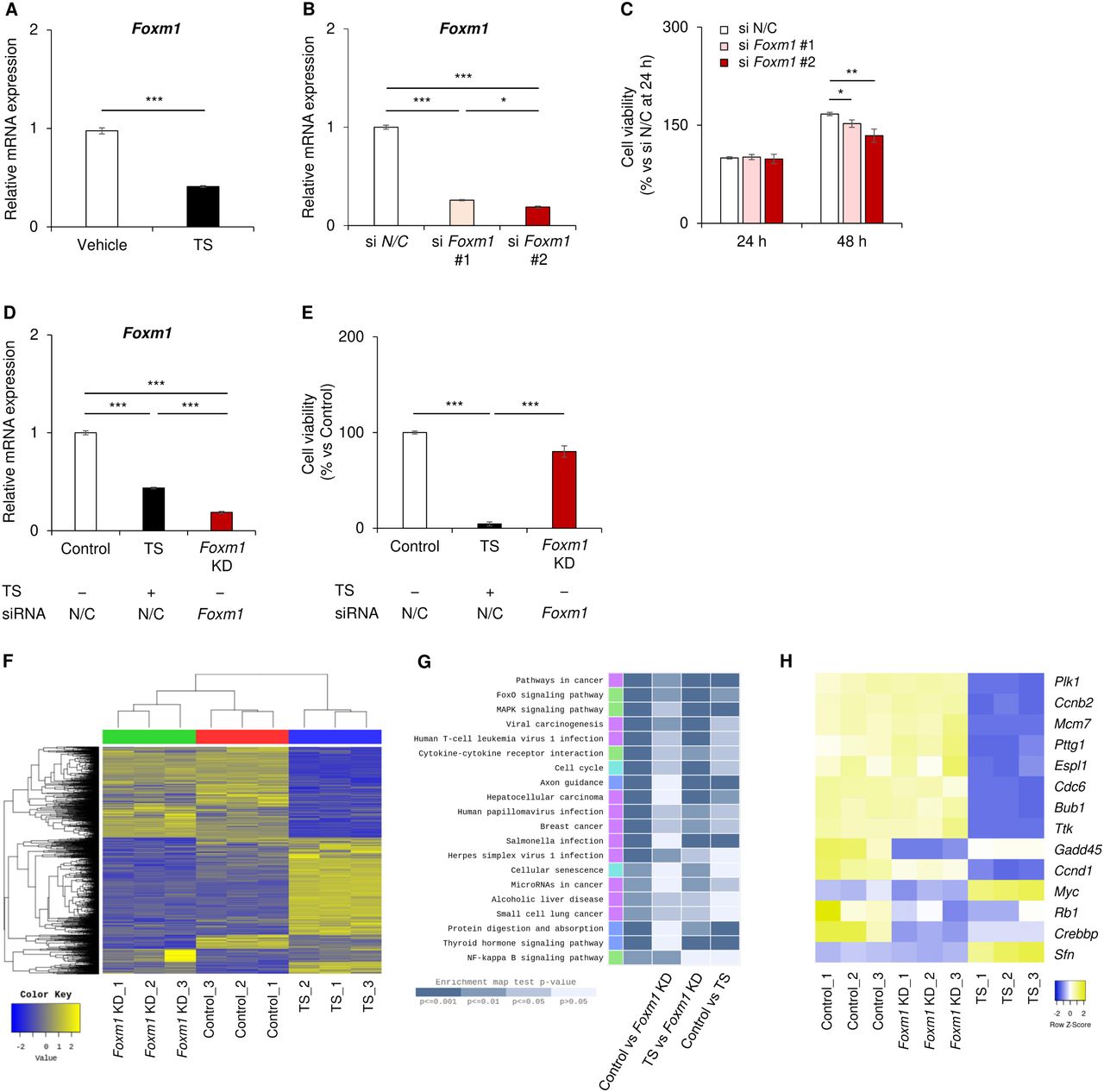
    (A) Quantitative RT-PCR of <t>Foxm1</t> mRNA in AtT-20 cells treated with 2 μM TS for 24 h. n = 6 each. (B, C) Quantitative RT-PCR of Foxm1 mRNA (B) and cell viability (C) of AtT-20 cells with Foxm1 knockdown (KD) by transfection with short interfering RNA (siRNA). A negative control siRNA (si N/C) was used, along with two siRNAs for Foxm1 (si Foxm1 #1 and si Foxm1 #2). RNA samples were collected after 24 h and cell viability was evaluated at both 24 and 48 h after transfections. Results are shown as the ratio relative to si N/C at 24 h. n = 6 each. (D, E) Quantitative RT-PCR of Foxm1 mRNA (D) and cell viability (E) of AtT-20 cells treated with TS and/or with Foxm1 knockdown. The Control group was treated with vehicle and transfected with si N/C, the TS group with 2 μM TS and si N/C, and the Foxm1 KD group with vehicle and si Foxm1 #2. n = 6 each. (F–H) Results of RNA-sequencing (RNA-seq) using RNA samples obtained in the experiments shown in panels D and E. Samples were analyzed as a mix of every two samples. n = 3 each. Panels F–H show hierarchical clustering (F), the top 20 terms from the enrichment analysis by the Kyoto Encyclopedia of Genes and Genomes (KEGG) (G), and DEGs associated with the cell cycle pathway in KEGG (H). DEGs were determined as an adjusted p < 0.05 and fold changes ≤ −2 or ≥ 2. Data of quantitative RT-PCR are normalized by means of Actb and Gapdh . Data are represented as means ± SEM. Statistical analyses were performed using the Student’s t -test for a panel A, and ANOVA followed by the Tukey-Kramer test for panels B–E. The p -value is presented as * p < 0.05, ** p < 0.01, and *** p < 0.001.
    Mouse Monoclonal Anti Foxm1 Antibody, supplied by Santa Cruz Biotechnology, used in various techniques. Bioz Stars score: 97/100, based on 1 PubMed citations. ZERO BIAS - scores, article reviews, protocol conditions and more
    https://www.bioz.com/result/mouse monoclonal anti foxm1 antibody/product/Santa Cruz Biotechnology
    Average 97 stars, based on 1 article reviews
    mouse monoclonal anti foxm1 antibody - by Bioz Stars, 2026-02
    97/100 stars
      Buy from Supplier

    97
    Santa Cruz Biotechnology mouse anti foxm1
    (A) Quantitative RT-PCR of <t>Foxm1</t> mRNA in AtT-20 cells treated with 2 μM TS for 24 h. n = 6 each. (B, C) Quantitative RT-PCR of Foxm1 mRNA (B) and cell viability (C) of AtT-20 cells with Foxm1 knockdown (KD) by transfection with short interfering RNA (siRNA). A negative control siRNA (si N/C) was used, along with two siRNAs for Foxm1 (si Foxm1 #1 and si Foxm1 #2). RNA samples were collected after 24 h and cell viability was evaluated at both 24 and 48 h after transfections. Results are shown as the ratio relative to si N/C at 24 h. n = 6 each. (D, E) Quantitative RT-PCR of Foxm1 mRNA (D) and cell viability (E) of AtT-20 cells treated with TS and/or with Foxm1 knockdown. The Control group was treated with vehicle and transfected with si N/C, the TS group with 2 μM TS and si N/C, and the Foxm1 KD group with vehicle and si Foxm1 #2. n = 6 each. (F–H) Results of RNA-sequencing (RNA-seq) using RNA samples obtained in the experiments shown in panels D and E. Samples were analyzed as a mix of every two samples. n = 3 each. Panels F–H show hierarchical clustering (F), the top 20 terms from the enrichment analysis by the Kyoto Encyclopedia of Genes and Genomes (KEGG) (G), and DEGs associated with the cell cycle pathway in KEGG (H). DEGs were determined as an adjusted p < 0.05 and fold changes ≤ −2 or ≥ 2. Data of quantitative RT-PCR are normalized by means of Actb and Gapdh . Data are represented as means ± SEM. Statistical analyses were performed using the Student’s t -test for a panel A, and ANOVA followed by the Tukey-Kramer test for panels B–E. The p -value is presented as * p < 0.05, ** p < 0.01, and *** p < 0.001.
    Mouse Anti Foxm1, supplied by Santa Cruz Biotechnology, used in various techniques. Bioz Stars score: 97/100, based on 1 PubMed citations. ZERO BIAS - scores, article reviews, protocol conditions and more
    https://www.bioz.com/result/mouse anti foxm1/product/Santa Cruz Biotechnology
    Average 97 stars, based on 1 article reviews
    mouse anti foxm1 - by Bioz Stars, 2026-02
    97/100 stars
      Buy from Supplier

    97
    Santa Cruz Biotechnology mouse monoclonal foxm1 g 5
    (A) Quantitative RT-PCR of <t>Foxm1</t> mRNA in AtT-20 cells treated with 2 μM TS for 24 h. n = 6 each. (B, C) Quantitative RT-PCR of Foxm1 mRNA (B) and cell viability (C) of AtT-20 cells with Foxm1 knockdown (KD) by transfection with short interfering RNA (siRNA). A negative control siRNA (si N/C) was used, along with two siRNAs for Foxm1 (si Foxm1 #1 and si Foxm1 #2). RNA samples were collected after 24 h and cell viability was evaluated at both 24 and 48 h after transfections. Results are shown as the ratio relative to si N/C at 24 h. n = 6 each. (D, E) Quantitative RT-PCR of Foxm1 mRNA (D) and cell viability (E) of AtT-20 cells treated with TS and/or with Foxm1 knockdown. The Control group was treated with vehicle and transfected with si N/C, the TS group with 2 μM TS and si N/C, and the Foxm1 KD group with vehicle and si Foxm1 #2. n = 6 each. (F–H) Results of RNA-sequencing (RNA-seq) using RNA samples obtained in the experiments shown in panels D and E. Samples were analyzed as a mix of every two samples. n = 3 each. Panels F–H show hierarchical clustering (F), the top 20 terms from the enrichment analysis by the Kyoto Encyclopedia of Genes and Genomes (KEGG) (G), and DEGs associated with the cell cycle pathway in KEGG (H). DEGs were determined as an adjusted p < 0.05 and fold changes ≤ −2 or ≥ 2. Data of quantitative RT-PCR are normalized by means of Actb and Gapdh . Data are represented as means ± SEM. Statistical analyses were performed using the Student’s t -test for a panel A, and ANOVA followed by the Tukey-Kramer test for panels B–E. The p -value is presented as * p < 0.05, ** p < 0.01, and *** p < 0.001.
    Mouse Monoclonal Foxm1 G 5, supplied by Santa Cruz Biotechnology, used in various techniques. Bioz Stars score: 97/100, based on 1 PubMed citations. ZERO BIAS - scores, article reviews, protocol conditions and more
    https://www.bioz.com/result/mouse monoclonal foxm1 g 5/product/Santa Cruz Biotechnology
    Average 97 stars, based on 1 article reviews
    mouse monoclonal foxm1 g 5 - by Bioz Stars, 2026-02
    97/100 stars
      Buy from Supplier

    97
    Santa Cruz Biotechnology monoclonal mouse anti foxm1
    (A) Quantitative RT-PCR of <t>Foxm1</t> mRNA in AtT-20 cells treated with 2 μM TS for 24 h. n = 6 each. (B, C) Quantitative RT-PCR of Foxm1 mRNA (B) and cell viability (C) of AtT-20 cells with Foxm1 knockdown (KD) by transfection with short interfering RNA (siRNA). A negative control siRNA (si N/C) was used, along with two siRNAs for Foxm1 (si Foxm1 #1 and si Foxm1 #2). RNA samples were collected after 24 h and cell viability was evaluated at both 24 and 48 h after transfections. Results are shown as the ratio relative to si N/C at 24 h. n = 6 each. (D, E) Quantitative RT-PCR of Foxm1 mRNA (D) and cell viability (E) of AtT-20 cells treated with TS and/or with Foxm1 knockdown. The Control group was treated with vehicle and transfected with si N/C, the TS group with 2 μM TS and si N/C, and the Foxm1 KD group with vehicle and si Foxm1 #2. n = 6 each. (F–H) Results of RNA-sequencing (RNA-seq) using RNA samples obtained in the experiments shown in panels D and E. Samples were analyzed as a mix of every two samples. n = 3 each. Panels F–H show hierarchical clustering (F), the top 20 terms from the enrichment analysis by the Kyoto Encyclopedia of Genes and Genomes (KEGG) (G), and DEGs associated with the cell cycle pathway in KEGG (H). DEGs were determined as an adjusted p < 0.05 and fold changes ≤ −2 or ≥ 2. Data of quantitative RT-PCR are normalized by means of Actb and Gapdh . Data are represented as means ± SEM. Statistical analyses were performed using the Student’s t -test for a panel A, and ANOVA followed by the Tukey-Kramer test for panels B–E. The p -value is presented as * p < 0.05, ** p < 0.01, and *** p < 0.001.
    Monoclonal Mouse Anti Foxm1, supplied by Santa Cruz Biotechnology, used in various techniques. Bioz Stars score: 97/100, based on 1 PubMed citations. ZERO BIAS - scores, article reviews, protocol conditions and more
    https://www.bioz.com/result/monoclonal mouse anti foxm1/product/Santa Cruz Biotechnology
    Average 97 stars, based on 1 article reviews
    monoclonal mouse anti foxm1 - by Bioz Stars, 2026-02
    97/100 stars
      Buy from Supplier

    90
    Santa Cruz Biotechnology mouse anti-foxm1 sc-376471
    (A) Quantitative RT-PCR of <t>Foxm1</t> mRNA in AtT-20 cells treated with 2 μM TS for 24 h. n = 6 each. (B, C) Quantitative RT-PCR of Foxm1 mRNA (B) and cell viability (C) of AtT-20 cells with Foxm1 knockdown (KD) by transfection with short interfering RNA (siRNA). A negative control siRNA (si N/C) was used, along with two siRNAs for Foxm1 (si Foxm1 #1 and si Foxm1 #2). RNA samples were collected after 24 h and cell viability was evaluated at both 24 and 48 h after transfections. Results are shown as the ratio relative to si N/C at 24 h. n = 6 each. (D, E) Quantitative RT-PCR of Foxm1 mRNA (D) and cell viability (E) of AtT-20 cells treated with TS and/or with Foxm1 knockdown. The Control group was treated with vehicle and transfected with si N/C, the TS group with 2 μM TS and si N/C, and the Foxm1 KD group with vehicle and si Foxm1 #2. n = 6 each. (F–H) Results of RNA-sequencing (RNA-seq) using RNA samples obtained in the experiments shown in panels D and E. Samples were analyzed as a mix of every two samples. n = 3 each. Panels F–H show hierarchical clustering (F), the top 20 terms from the enrichment analysis by the Kyoto Encyclopedia of Genes and Genomes (KEGG) (G), and DEGs associated with the cell cycle pathway in KEGG (H). DEGs were determined as an adjusted p < 0.05 and fold changes ≤ −2 or ≥ 2. Data of quantitative RT-PCR are normalized by means of Actb and Gapdh . Data are represented as means ± SEM. Statistical analyses were performed using the Student’s t -test for a panel A, and ANOVA followed by the Tukey-Kramer test for panels B–E. The p -value is presented as * p < 0.05, ** p < 0.01, and *** p < 0.001.
    Mouse Anti Foxm1 Sc 376471, supplied by Santa Cruz Biotechnology, used in various techniques. Bioz Stars score: 90/100, based on 1 PubMed citations. ZERO BIAS - scores, article reviews, protocol conditions and more
    https://www.bioz.com/result/mouse anti-foxm1 sc-376471/product/Santa Cruz Biotechnology
    Average 90 stars, based on 1 article reviews
    mouse anti-foxm1 sc-376471 - by Bioz Stars, 2026-02
    90/100 stars
      Buy from Supplier

    97
    Santa Cruz Biotechnology mouse anti e2f1
    (A) Quantitative RT-PCR of <t>Foxm1</t> mRNA in AtT-20 cells treated with 2 μM TS for 24 h. n = 6 each. (B, C) Quantitative RT-PCR of Foxm1 mRNA (B) and cell viability (C) of AtT-20 cells with Foxm1 knockdown (KD) by transfection with short interfering RNA (siRNA). A negative control siRNA (si N/C) was used, along with two siRNAs for Foxm1 (si Foxm1 #1 and si Foxm1 #2). RNA samples were collected after 24 h and cell viability was evaluated at both 24 and 48 h after transfections. Results are shown as the ratio relative to si N/C at 24 h. n = 6 each. (D, E) Quantitative RT-PCR of Foxm1 mRNA (D) and cell viability (E) of AtT-20 cells treated with TS and/or with Foxm1 knockdown. The Control group was treated with vehicle and transfected with si N/C, the TS group with 2 μM TS and si N/C, and the Foxm1 KD group with vehicle and si Foxm1 #2. n = 6 each. (F–H) Results of RNA-sequencing (RNA-seq) using RNA samples obtained in the experiments shown in panels D and E. Samples were analyzed as a mix of every two samples. n = 3 each. Panels F–H show hierarchical clustering (F), the top 20 terms from the enrichment analysis by the Kyoto Encyclopedia of Genes and Genomes (KEGG) (G), and DEGs associated with the cell cycle pathway in KEGG (H). DEGs were determined as an adjusted p < 0.05 and fold changes ≤ −2 or ≥ 2. Data of quantitative RT-PCR are normalized by means of Actb and Gapdh . Data are represented as means ± SEM. Statistical analyses were performed using the Student’s t -test for a panel A, and ANOVA followed by the Tukey-Kramer test for panels B–E. The p -value is presented as * p < 0.05, ** p < 0.01, and *** p < 0.001.
    Mouse Anti E2f1, supplied by Santa Cruz Biotechnology, used in various techniques. Bioz Stars score: 97/100, based on 1 PubMed citations. ZERO BIAS - scores, article reviews, protocol conditions and more
    https://www.bioz.com/result/mouse anti e2f1/product/Santa Cruz Biotechnology
    Average 97 stars, based on 1 article reviews
    mouse anti e2f1 - by Bioz Stars, 2026-02
    97/100 stars
      Buy from Supplier

    Image Search Results


    FIGURE 1 SIRT2 and FOXM1 immunostaining and correlation in human colon cancer. (A) Representation images of the strong, moderate, and weak SIRT2 (upper panel) and FOXM1 (lower panel) staining of colon tissue sections from the same tumors were presented. Samples were counterstained with hematoxylin and scored semi‐quantifiably according to staining intensities. Bar = 100 μm. *Independent‐Samples t‐test, **Pearson Chi‐Square. (B) Correlation between SIRT2 and FOXM1 gene expressions. Gene expressions were obtained from TCGA‐COAD Project Database and correlation was analyzed with Spearman's rho. A negative Spearman correlation (−0.3084) was found between the genes (p < 0.001).

    Journal: Journal of biochemical and molecular toxicology

    Article Title: SIRT2 deacetylates and decreases the expression of FOXM1 in colon cancer.

    doi: 10.1002/jbt.70018

    Figure Lengend Snippet: FIGURE 1 SIRT2 and FOXM1 immunostaining and correlation in human colon cancer. (A) Representation images of the strong, moderate, and weak SIRT2 (upper panel) and FOXM1 (lower panel) staining of colon tissue sections from the same tumors were presented. Samples were counterstained with hematoxylin and scored semi‐quantifiably according to staining intensities. Bar = 100 μm. *Independent‐Samples t‐test, **Pearson Chi‐Square. (B) Correlation between SIRT2 and FOXM1 gene expressions. Gene expressions were obtained from TCGA‐COAD Project Database and correlation was analyzed with Spearman's rho. A negative Spearman correlation (−0.3084) was found between the genes (p < 0.001).

    Article Snippet: Sections were incubated with rabbit polyclonal SIRT2 (Sigma, St. Louis, MO, USA) or FOXM1 mouse monoclonal antibodies (Santa Cruz Biotechnology, CA, USA) at 1:50 dilutions overnight at 4°C.

    Techniques: Immunostaining, Staining

    FIGURE 2 (A) 40 μg protein lysates from FET, HCT116 p21−/−, HCT116, SW480, SW620, and Caco2 colon carcinoma cells were separated and subsequently immunoblotted with anti‐FOXM1, anti‐SIRT2, and anti‐β‐actin antibodies. (B) Quantification of protein band intensity was performed by ImageJ software. Bars are the mean ± S.D. Games–Howell posthoc: ab, ac, ae, ef, a′b′, a′c′, a′d′, a′e′, a′f′, b′c′, b′d′, c′e′, c′f′, d′e′, d′f′, e′f′ p < 0.05. (C–E) Stably SIRT2 overexpressing and control colon cancer (C) FET, (D) SW620, and (E) HCT116 were separated and subsequently immunoblotted with anti‐FOXM1, anti‐SIRT2, and anti‐GAPDH antibodies.

    Journal: Journal of biochemical and molecular toxicology

    Article Title: SIRT2 deacetylates and decreases the expression of FOXM1 in colon cancer.

    doi: 10.1002/jbt.70018

    Figure Lengend Snippet: FIGURE 2 (A) 40 μg protein lysates from FET, HCT116 p21−/−, HCT116, SW480, SW620, and Caco2 colon carcinoma cells were separated and subsequently immunoblotted with anti‐FOXM1, anti‐SIRT2, and anti‐β‐actin antibodies. (B) Quantification of protein band intensity was performed by ImageJ software. Bars are the mean ± S.D. Games–Howell posthoc: ab, ac, ae, ef, a′b′, a′c′, a′d′, a′e′, a′f′, b′c′, b′d′, c′e′, c′f′, d′e′, d′f′, e′f′ p < 0.05. (C–E) Stably SIRT2 overexpressing and control colon cancer (C) FET, (D) SW620, and (E) HCT116 were separated and subsequently immunoblotted with anti‐FOXM1, anti‐SIRT2, and anti‐GAPDH antibodies.

    Article Snippet: Sections were incubated with rabbit polyclonal SIRT2 (Sigma, St. Louis, MO, USA) or FOXM1 mouse monoclonal antibodies (Santa Cruz Biotechnology, CA, USA) at 1:50 dilutions overnight at 4°C.

    Techniques: Software, Stable Transfection, Control

    FIGURE 3 SIRT2 interacted with FOXM1. (A–D) Subcellular localization of SIRT2 and FOXM1 proteins in human colorectal cancer line HCT116. (A) SIRT2; (B) FOXM1; (C) DAPI; (D) image obtained by overlapping layers. Green channel: SIRT2, red channel: FOXM1, blue channel: DAPI. (E) 293T cells were transfected with 5 μg Flag‐SIRT2 followed by immunoprecipitation of 1 mg total protein lysate with an anti‐Flag antibody. Isolated samples were separated and subsequently immunoblotted with an anti‐FOXM1 antibody. (F) SIRT2 protein was immunoprecipitated with an anti‐SIRT2 antibody from 1 mg total protein lysate of HCT116 cells. Anti‐IgG IP from the same amount of protein lysate was used as a negative control. Input immune blotted is shown as a positive control.

    Journal: Journal of biochemical and molecular toxicology

    Article Title: SIRT2 deacetylates and decreases the expression of FOXM1 in colon cancer.

    doi: 10.1002/jbt.70018

    Figure Lengend Snippet: FIGURE 3 SIRT2 interacted with FOXM1. (A–D) Subcellular localization of SIRT2 and FOXM1 proteins in human colorectal cancer line HCT116. (A) SIRT2; (B) FOXM1; (C) DAPI; (D) image obtained by overlapping layers. Green channel: SIRT2, red channel: FOXM1, blue channel: DAPI. (E) 293T cells were transfected with 5 μg Flag‐SIRT2 followed by immunoprecipitation of 1 mg total protein lysate with an anti‐Flag antibody. Isolated samples were separated and subsequently immunoblotted with an anti‐FOXM1 antibody. (F) SIRT2 protein was immunoprecipitated with an anti‐SIRT2 antibody from 1 mg total protein lysate of HCT116 cells. Anti‐IgG IP from the same amount of protein lysate was used as a negative control. Input immune blotted is shown as a positive control.

    Article Snippet: Sections were incubated with rabbit polyclonal SIRT2 (Sigma, St. Louis, MO, USA) or FOXM1 mouse monoclonal antibodies (Santa Cruz Biotechnology, CA, USA) at 1:50 dilutions overnight at 4°C.

    Techniques: Transfection, Immunoprecipitation, Isolation, Negative Control, Positive Control

    FIGURE 5 Effects of SIRT activators and inhibitors on FOXM1 and SIRT2 protein expressions. HCT116 cells were seeded in sterile petri dishes at a cell count of approximately 106 and allowed to reach approximately 60–70% for approximately 24 h. Resveratrol (100 μM), melatonin (2 mM), berberine (50 μm), quercetin (100 μM), honokiol (10 μM), SRT1720 (5 μM), EX527 (100 μM), AGK2 (10 μM) and SirReal2 (100 μM) were added to the medium containing the cells and exposed for 24 h. Protein extracts were prepared, separated, and immunoblotted with anti‐FOXM1 and anti‐SIRT2 and anti‐β‐actin antibodies as described in the materials and methods section. The experiment was repeated at least three times. Bars are the mean ± S.D. Games–Howell posthoc: ae, ag, aj, bh, bi, cg, cj, dh, ef, ej, fj, gj, hj, ij p < 0.05, ad, af, bg, bj, cd, ce, cf, de, df, di p < 0.01, ab, bc, be, bf, dg, dj p < 0.001.

    Journal: Journal of biochemical and molecular toxicology

    Article Title: SIRT2 deacetylates and decreases the expression of FOXM1 in colon cancer.

    doi: 10.1002/jbt.70018

    Figure Lengend Snippet: FIGURE 5 Effects of SIRT activators and inhibitors on FOXM1 and SIRT2 protein expressions. HCT116 cells were seeded in sterile petri dishes at a cell count of approximately 106 and allowed to reach approximately 60–70% for approximately 24 h. Resveratrol (100 μM), melatonin (2 mM), berberine (50 μm), quercetin (100 μM), honokiol (10 μM), SRT1720 (5 μM), EX527 (100 μM), AGK2 (10 μM) and SirReal2 (100 μM) were added to the medium containing the cells and exposed for 24 h. Protein extracts were prepared, separated, and immunoblotted with anti‐FOXM1 and anti‐SIRT2 and anti‐β‐actin antibodies as described in the materials and methods section. The experiment was repeated at least three times. Bars are the mean ± S.D. Games–Howell posthoc: ae, ag, aj, bh, bi, cg, cj, dh, ef, ej, fj, gj, hj, ij p < 0.05, ad, af, bg, bj, cd, ce, cf, de, df, di p < 0.01, ab, bc, be, bf, dg, dj p < 0.001.

    Article Snippet: Sections were incubated with rabbit polyclonal SIRT2 (Sigma, St. Louis, MO, USA) or FOXM1 mouse monoclonal antibodies (Santa Cruz Biotechnology, CA, USA) at 1:50 dilutions overnight at 4°C.

    Techniques: Sterility, Cell Counting

    FIGURE 4 FOXM1 could be hyperacetylated and SIRT2 deacetylated FOXM1. (A) 293T cells were transfected with 5 μg FOXM1 and 2 μg of each HAT (p300 and pCAF) and 48 h after transfection, cell extracts were immunoprecipitated with an anti‐FOXM1 antibody, separated and subsequently immunoblotted with anti‐SIRT2 and anti‐FOXM1 antibodies. (B) Purified acetylated FOXM1 was mixed with purified SIRT2, without or with NAD+, and samples were immunoblotted with anti‐acetyl‐lysine and anti‐FOXM1 antibodies. Input immune blotted is shown as a positive control.

    Journal: Journal of biochemical and molecular toxicology

    Article Title: SIRT2 deacetylates and decreases the expression of FOXM1 in colon cancer.

    doi: 10.1002/jbt.70018

    Figure Lengend Snippet: FIGURE 4 FOXM1 could be hyperacetylated and SIRT2 deacetylated FOXM1. (A) 293T cells were transfected with 5 μg FOXM1 and 2 μg of each HAT (p300 and pCAF) and 48 h after transfection, cell extracts were immunoprecipitated with an anti‐FOXM1 antibody, separated and subsequently immunoblotted with anti‐SIRT2 and anti‐FOXM1 antibodies. (B) Purified acetylated FOXM1 was mixed with purified SIRT2, without or with NAD+, and samples were immunoblotted with anti‐acetyl‐lysine and anti‐FOXM1 antibodies. Input immune blotted is shown as a positive control.

    Article Snippet: Sections were incubated with rabbit polyclonal SIRT2 (Sigma, St. Louis, MO, USA) or FOXM1 mouse monoclonal antibodies (Santa Cruz Biotechnology, CA, USA) at 1:50 dilutions overnight at 4°C.

    Techniques: Transfection, Immunoprecipitation, Purification, Positive Control

    (A) Quantitative RT-PCR of Foxm1 mRNA in AtT-20 cells treated with 2 μM TS for 24 h. n = 6 each. (B, C) Quantitative RT-PCR of Foxm1 mRNA (B) and cell viability (C) of AtT-20 cells with Foxm1 knockdown (KD) by transfection with short interfering RNA (siRNA). A negative control siRNA (si N/C) was used, along with two siRNAs for Foxm1 (si Foxm1 #1 and si Foxm1 #2). RNA samples were collected after 24 h and cell viability was evaluated at both 24 and 48 h after transfections. Results are shown as the ratio relative to si N/C at 24 h. n = 6 each. (D, E) Quantitative RT-PCR of Foxm1 mRNA (D) and cell viability (E) of AtT-20 cells treated with TS and/or with Foxm1 knockdown. The Control group was treated with vehicle and transfected with si N/C, the TS group with 2 μM TS and si N/C, and the Foxm1 KD group with vehicle and si Foxm1 #2. n = 6 each. (F–H) Results of RNA-sequencing (RNA-seq) using RNA samples obtained in the experiments shown in panels D and E. Samples were analyzed as a mix of every two samples. n = 3 each. Panels F–H show hierarchical clustering (F), the top 20 terms from the enrichment analysis by the Kyoto Encyclopedia of Genes and Genomes (KEGG) (G), and DEGs associated with the cell cycle pathway in KEGG (H). DEGs were determined as an adjusted p < 0.05 and fold changes ≤ −2 or ≥ 2. Data of quantitative RT-PCR are normalized by means of Actb and Gapdh . Data are represented as means ± SEM. Statistical analyses were performed using the Student’s t -test for a panel A, and ANOVA followed by the Tukey-Kramer test for panels B–E. The p -value is presented as * p < 0.05, ** p < 0.01, and *** p < 0.001.

    Journal: bioRxiv

    Article Title: High-throughput screening for Cushing’s disease: therapeutic potential of thiostrepton via cell cycle regulation

    doi: 10.1101/2024.02.22.581351

    Figure Lengend Snippet: (A) Quantitative RT-PCR of Foxm1 mRNA in AtT-20 cells treated with 2 μM TS for 24 h. n = 6 each. (B, C) Quantitative RT-PCR of Foxm1 mRNA (B) and cell viability (C) of AtT-20 cells with Foxm1 knockdown (KD) by transfection with short interfering RNA (siRNA). A negative control siRNA (si N/C) was used, along with two siRNAs for Foxm1 (si Foxm1 #1 and si Foxm1 #2). RNA samples were collected after 24 h and cell viability was evaluated at both 24 and 48 h after transfections. Results are shown as the ratio relative to si N/C at 24 h. n = 6 each. (D, E) Quantitative RT-PCR of Foxm1 mRNA (D) and cell viability (E) of AtT-20 cells treated with TS and/or with Foxm1 knockdown. The Control group was treated with vehicle and transfected with si N/C, the TS group with 2 μM TS and si N/C, and the Foxm1 KD group with vehicle and si Foxm1 #2. n = 6 each. (F–H) Results of RNA-sequencing (RNA-seq) using RNA samples obtained in the experiments shown in panels D and E. Samples were analyzed as a mix of every two samples. n = 3 each. Panels F–H show hierarchical clustering (F), the top 20 terms from the enrichment analysis by the Kyoto Encyclopedia of Genes and Genomes (KEGG) (G), and DEGs associated with the cell cycle pathway in KEGG (H). DEGs were determined as an adjusted p < 0.05 and fold changes ≤ −2 or ≥ 2. Data of quantitative RT-PCR are normalized by means of Actb and Gapdh . Data are represented as means ± SEM. Statistical analyses were performed using the Student’s t -test for a panel A, and ANOVA followed by the Tukey-Kramer test for panels B–E. The p -value is presented as * p < 0.05, ** p < 0.01, and *** p < 0.001.

    Article Snippet: The primary antibodies used were a mouse monoclonal anti-FOXM1 antibody (1:500, sc-376471; Santa Cruz Biotechnology, Dallas, TX), and a mouse monoclonal antibody anti–β-actin antibody (1:2000, 010-27841; FUJIFILM Wako Pure Chemical, Osaka, Japan) as an endogenous control.

    Techniques: Quantitative RT-PCR, Knockdown, Transfection, Small Interfering RNA, Negative Control, Control, RNA Sequencing

    (A, B) Gene expression levels of cyclins in the Control, TS, and Foxm1 KD groups. Data are represented as transcript per kilobase million (TPM) for RNA-seq (A), and as relative expression levels compared to the Control group for quantitative RT-PCR (B). n = 3 for each group in panel A, and n = 6 for each group in panel B. (C–F) Cell cycle analyses using propidium iodide (PI) staining and flow cytometry for AtT-20 cells treated with TS (0, 2, and 4 μM) for 24 h. n = 6 each. (G–J) Evaluation of apoptosis using staining with Annexin V-FITC and PI and flow cytometry for AtT-20 cells treated with TS (0, 2, and 4 μM) for 48 h. n = 3 each. (K–M) Cell cycle analyses using PI staining and flow cytometry for AtT-20 cells treated with 5 μM palbociclib for 24 h. n = 6 each. (N) Cell viability of AtT-20 cells treated with a dilution series of palbociclib. Either vehicle or 2 μM TS was co-administered with palbociclib and analysis was performed after 48 h. Results are shown as the ratio relative to values without palbociclib and TS. n = 6 each. Data of quantitative RT-PCR are normalized by means of Actb and Gapdh . Data are represented as means ± SEM. Statistical analyses were performed using ANOVA followed by the Tukey-Kramer test for panels A, B, F, and J, the Student’s t -test for panel M, and ANOVA followed by the Dunnett test with comparisons to results without palbociclib administration for panel N. The p -value is presented as * p < 0.05, ** p < 0.01, and *** p < 0.001.

    Journal: bioRxiv

    Article Title: High-throughput screening for Cushing’s disease: therapeutic potential of thiostrepton via cell cycle regulation

    doi: 10.1101/2024.02.22.581351

    Figure Lengend Snippet: (A, B) Gene expression levels of cyclins in the Control, TS, and Foxm1 KD groups. Data are represented as transcript per kilobase million (TPM) for RNA-seq (A), and as relative expression levels compared to the Control group for quantitative RT-PCR (B). n = 3 for each group in panel A, and n = 6 for each group in panel B. (C–F) Cell cycle analyses using propidium iodide (PI) staining and flow cytometry for AtT-20 cells treated with TS (0, 2, and 4 μM) for 24 h. n = 6 each. (G–J) Evaluation of apoptosis using staining with Annexin V-FITC and PI and flow cytometry for AtT-20 cells treated with TS (0, 2, and 4 μM) for 48 h. n = 3 each. (K–M) Cell cycle analyses using PI staining and flow cytometry for AtT-20 cells treated with 5 μM palbociclib for 24 h. n = 6 each. (N) Cell viability of AtT-20 cells treated with a dilution series of palbociclib. Either vehicle or 2 μM TS was co-administered with palbociclib and analysis was performed after 48 h. Results are shown as the ratio relative to values without palbociclib and TS. n = 6 each. Data of quantitative RT-PCR are normalized by means of Actb and Gapdh . Data are represented as means ± SEM. Statistical analyses were performed using ANOVA followed by the Tukey-Kramer test for panels A, B, F, and J, the Student’s t -test for panel M, and ANOVA followed by the Dunnett test with comparisons to results without palbociclib administration for panel N. The p -value is presented as * p < 0.05, ** p < 0.01, and *** p < 0.001.

    Article Snippet: The primary antibodies used were a mouse monoclonal anti-FOXM1 antibody (1:500, sc-376471; Santa Cruz Biotechnology, Dallas, TX), and a mouse monoclonal antibody anti–β-actin antibody (1:2000, 010-27841; FUJIFILM Wako Pure Chemical, Osaka, Japan) as an endogenous control.

    Techniques: Gene Expression, Control, RNA Sequencing, Expressing, Quantitative RT-PCR, Staining, Flow Cytometry